Ultra Thin Battery Technology: How the LiMnO₂ Primary Pouch Cell CP223830 Powers Next-Gen Wearables, Medical Patches and IoT Devices
Ultra Thin Battery Technology: How the LiMnO₂ Primary Pouch Cell CP223830 Powers Next-Gen Wearables, Medical Patches and IoT Devices
Published by SER GROUP LIMITED / Guangzhou Serui Battery Technology Co., Ltd. — www.serui-battery.com
Introduction
The consumer electronics industry is in the middle of a quiet but fundamental shift. Devices are no longer getting smaller in only one dimension — they are getting flatter. Smartwatches are becoming slimmer, medical patches are being integrated directly into clothing, RFID tags are being embedded in credit cards and passports, and industrial sensors are being taped onto structures where there is simply no room for a cylindrical or coin cell. Behind every one of these product teams is the same engineering challenge: how to deliver reliable, long-lasting power in a form factor thinner than a credit card?
The answer that has emerged over the last decade is the ultra thin battery — a flat, flexible, card-shaped power source that sits inside the product rather than occupying a chassis. Among the chemistries available for this form factor, the LiMnO₂ battery (lithium manganese dioxide, or Li-MnO₂) has become the default choice for design teams that need a stable 3.0V rail, a 10+ year shelf life, and operation across extreme temperatures. And within that category, the primary pouch cell has replaced the old coin-cell and prismatic sealed designs wherever thinness, weight and design freedom matter.
This article takes a deep look at how the LiMnO₂ primary pouch cell works, why it has become the power source of choice for wearables, medical devices and active IoT, and how our flagship model CP223830 — a 3.0V 400mAh ultra thin LiMnO₂ pouch cell measuring just 2.4 mm thick — is being designed into products on every continent. If you are an engineering manager, product designer or procurement lead evaluating thin lithium batteries for your next generation, by the end of this piece you will know exactly what specs to ask for, what pitfalls to avoid, and why www.serui-battery.com is increasingly the first call that OEMs make.
The Rise of the Ultra Thin Battery
1.1 What does "ultra thin" actually mean?
An ultra thin battery is generally defined as a primary or secondary cell whose total thickness is at or below 3 mm, and whose planar dimensions can be customised to fit the product. In practice, the market splits ultra thin cells into three tiers:
Standard thin pouch cells (3–5 mm) — used in smartphones, power banks and slimmer wearables.
True ultra thin cells (1.5–3 mm) — the sweet spot for smart cards, medical patches, smart labels and compact sensor nodes.
Flexible / bendable cells (<1 mm) — emerging for e-textiles and curved wearables, but still limited in capacity.
The CP223830 sits squarely in the second tier: a maximum thickness of 2.4 mm, planar dimensions of 38.5 mm × 31 mm, and a weight of only 3.8 grams. To put that in context, a standard CR2032 coin cell is 3.2 mm thick and weighs 3.0 g — yet the CP223830 delivers more than double the capacity (400 mAh vs. around 220 mAh) in a form that can be laminated, taped or heat-sealed inside a product rather than housed in a battery compartment.
1.2 Why demand for thin cells is accelerating
Three macro trends are converging:
Wearable aesthetics. Consumers reject "brick on the wrist." A smartwatch or fitness band must disappear under clothing, which means the battery must disappear under the PCB. A cylindrical cell simply cannot deliver that.
The patch-of-things. Medical wearables (continuous glucose monitors, ECG Holter patches, drug delivery patches) require a battery that can be adhered to skin, bent with the body, and discarded after 7–30 days. Only a flat primary pouch cell makes this possible.
Battery-as-a-label. Active RFID, NFC tags, retail electronic shelf labels and cold-chain loggers are being printed or laminated into packaging. These products are single-use by design, which makes a low-self-discharge primary pouch cell economically and environmentally the only sensible option.
According to market analyses, the global thin and flexible battery market is growing at a double-digit CAGR, driven largely by medical and industrial IoT rather than by consumer wearables alone. Engineering teams that source LiMnO₂ battery technology early are the ones who can hit their product-roadmap windows.
LiMnO₂ Battery Chemistry: Why 3.0V Primary Power Matters
2.1 What is a Li-MnO₂ cell?
A LiMnO₂ battery is a primary (non-rechargeable) lithium cell whose anode is metallic lithium and whose cathode is manganese dioxide. The electrolyte is an organic solvent with a lithium salt, typically LiClO₄. When the cell discharges, lithium ions move from the anode through the separator to the manganese dioxide cathode, producing a nominal voltage of 3.0 V — exactly double the 1.5 V of an alkaline cell.
The chemistry was commercialised in the 1970s and has matured into one of the most reliable primary chemistries ever fielded. Its key properties:
High open-circuit voltage (~3.3 V) and flat 3.0 V discharge plateau. Most of the 400 mAh in a CP223830 is delivered at a voltage between 2.9 V and 3.0 V, which means a single cell can directly power low-voltage microelectronics (MCUs, BLE radios, sensor ICs) without the efficiency loss of a boost converter.
Very low self-discharge. At 23 °C, a Li-MnO₂ cell typically loses less than 1% per year — and the CP223830 is specified at 2% per year maximum. This is what enables a 10+ year shelf life, critical for devices that sit in a warehouse or on a shelf before deployment.
Wide temperature tolerance. Li-MnO₂ chemistry reliably discharges from −40 °C to +60 °C, outperforming both alkaline (which dies below −20 °C) and most Li-SOCl₂ variants in high-current pulses.
High energy density. The CP223830 delivers 400 mAh at 3.0 V = 1.2 Wh in 3.8 g — an energy density of roughly 315 Wh/kg, far above alkaline and competitive with much larger primary chemistries.
2.2 LiMnO₂ vs. competing primary chemistries
Chemistry | Nominal voltage | Typical shelf life | Temperature range | Best application |
Li-MnO₂ (CP223830) | 3.0 V | 10+ years | −40 to +60 °C | Wearables, RFID, medical, sensors |
Li-SOCl₂ | 3.6 V | 15+ years | −60 to +85 °C | Ultra-low-current metering, smart meters |
Li-FeS₂ (Li-FeS₂) | 1.5 V | 10 years | −40 to +60 °C | Direct alkaline drop-in replacement |
Alaline (Zn-MnO₂) | 1.5 V | 3–5 years | 0 to +60 °C | Low-cost, disposable |
Li-CFₓ | 3.0 V | 10 years | −40 to +85 °C | High-pulse RFID, TPMS |
For most wearable, medical and active-RFID use cases, the LiMnO₂ battery is the optimum compromise: it delivers higher pulses than Li-SOCl₂ (which excels at micro-current but struggles with BLE/GSM bursts), costs less than Li-CFₓ, and runs twice the voltage of alkaline.
2.3 Why "primary" is the right call for many products
A common question from design engineers is: why not just use a small LiPo rechargeable? The answer depends on the product's lifetime and use pattern:
If the device is sealed, disposable or deployed for >3 years, a rechargeable cell's self-discharge and charging-circuit overhead make it the wrong choice.
If the device must survive 5–10 years on a shelf before activation, a primary cell's 2%/year loss beats a LiPo's 5–10%/year.
If the device has no space for a USB port or charging IC, primary is the only option.
This is why the primary pouch cell segment is growing faster than the thin rechargeable segment in industrial and medical IoT.
The Primary Pouch Cell Form Factor: Redefining Design Freedom
3.1 From coin cans to laminated pouches
Traditional lithium primary cells come in cylindrical (ER-series) or coin (CR-series) metal cans. They are robust, but:
They are round, wasting valuable PCB area.
They have a fixed thickness (e.g. CR2032 = 3.2 mm) that cannot be reduced.
They require a holder, contacts and a sealed compartment, adding mechanical cost.
A primary pouch cell is built differently. The Li-MnO₂ electrode stack is hermetically sealed in an aluminium-laminated film rather than a steel can. This brings four structural advantages:
Thinness. Without a thick steel wall, the cell can be 2.0–2.5 mm thick, limited only by the electrode stack itself.
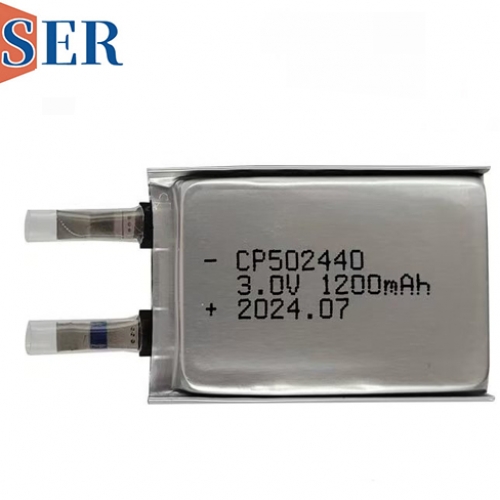
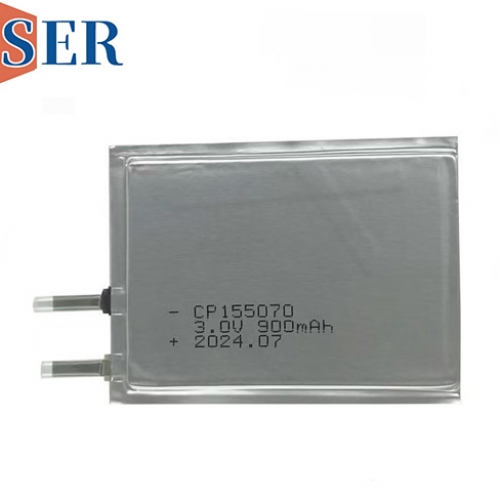
Customisable footprint. The laminated film can be die-cut to almost any rectangular shape. CP223830's 2.4 × 38.5 × 31 mm card shape is a standard, but custom sizes (e.g. CP205030, CP124040, CP012525) are routinely manufactured at www.serui-battery.com.
Light weight. The laminate film weighs a fraction of a steel can — the CP223830 totals only 3.8 g.
Lamination-friendly assembly. The flat, smooth surface can be bonded directly to a PCB or housing with double-sided tape, eliminating holders.
3.2 Safety features of a well-engineered pouch cell
A common misconception is that pouch cells are inherently less safe than canned cells. In reality, a properly designed LiMnO₂ primary pouch cell includes:
A hermetic edge seal that prevents electrolyte leakage over a 10+ year life.
A current interrupt device (CID) in many models that vents internal pressure in the event of abuse.
UL 1642 and IEC 600831 certification, and UN 38.3 transport testing.
The CP223830 is certified to UL, UN38.3 and RoHS, meaning it can be shipped globally by air, sea and post without special dispensation — a non-trivial benefit for an OEM that sells into 20+ countries.
Product Spotlight: CP223830 — A 2.4 mm Ultra Thin LiMnO₂ Battery
4.1 Key specifications
The CP223830 is SERUI's flagship ultra thin LiMnO₂ pouch cell, purpose-built for wearable, medical and active-RFID applications.
Parameter | CP223830 specification |
Chemistry | Lithium Manganese Dioxide (Li-MnO₂), primary |
Nominal voltage | 3.0 V |
Nominal capacity | 400 mAh (at 1 mA discharge to 2.0 V, 23 °C) |
Maximum continuous current | 100 mA |
Maximum pulse current | 150 mA (3 s on / 27 s off) |
Max. dimensions | 2.4 mm × 38.5 mm × 31 mm |
Weight | 3.8 g |
Operating temperature | −40 °C to +60 °C |
Storage temperature | ≤ 30 °C, ≤ 75 % RH |
Self-discharge | ≤ 2 % per year (at 23 °C) |
Certifications | UL, UN38.3, RoHS |
Termination options | Custom tabs, solder pads, wires or connectors |
4.2 Why 2.4 mm matters
At 2.4 mm thick, the CP223830 is roughly the thickness of three stacked credit cards. This is thin enough to fit inside:
A smartwatch band or watch case (typical watch case backs are 8–12 mm total; a 2.4 mm battery leaves 6–9 mm for the PCB, display and sensors).
A medical ECG patch adhered to the chest (patches thinner than 3 mm are generally perceived as "invisible" by the wearer).
A smart card or ID badge laminate (standard card thickness is 0.76 mm for the card itself, but an embedded battery module can be up to 2.5 mm in a credit-card-sized holder).
An active RFID tag or electronic shelf label, where the battery is laminated between the antenna and the label face.
The 400 mAh capacity is equally deliberate. A typical BLE beacon draws 10–15 mA during transmission but only 5 µA in sleep. At 400 mAh, the CP223830 can power a BLE beacon transmitting once every 2 seconds for 2–3 years — far longer than the product's intended service life. A medical patch drawing 200 µA average can run for 6–8 months on one cell.
4.3 Pulse performance for radio modules
One of the most common engineering questions is whether a primary pouch cell can handle the current spikes of BLE, Zigbee, LoRa or GSM modules. The CP223830 is rated for:
100 mA continuous — enough for most BLE, Zigbee and LoRa transmitters.
150 mA pulse (3 s on, 27 s off) — sufficient for GSM/GPRS burst transmissions such as those in GPS trackers or remote sensors.
This is a meaningful advantage over Li-SOCl₂ cells of the same capacity, which typically have much lower pulse limits and require a reservoir capacitor to handle radio bursts.
4.4 Customisation at the pouch level
Although CP223830 is a standard model, SERUI engineers routinely modify:
Tab length and position to match the PCB layout.
Termination type — bare nickel tabs, tinned leads, JST/Pico connectors, or adhesive-backed contacts.
Packaging — individual blister, anti-static bag, or taped-and-reeled for automated assembly.
Voltage and capacity grading for high-volume production runs.
This customisation capability is what differentiates a true primary pouch cell manufacturer from a trading company reselling generic stock.
Real-World Applications of the CP223830
5.1 Wearable devices
The most visible application of an ultra thin LiMnO₂ battery is in wearables: smart bands, fitness trackers, hearables, posture correctors and smart clothing. The CP223830's 2.4 mm thickness and 3.8 g weight mean it can be sewn or taped into a band without creating a pressure point. The 10+ year shelf life is also critical for wearable inventory that may sit in a retail channel for 6–12 months before purchase.
5.2 Medical equipment
Medical patches — continuous glucose monitors, ambulatory ECG Holters, drug-delivery patches, temperature loggers for vaccine transport — require a battery that is skin-safe, low-self-discharge and capable of years of shelf life before clinical use. The Li-MnO₂ chemistry is already the dominant chemistry in disposable medical devices, and the CP223830's 400 mAh capacity makes it suitable for patches running 7–30 days of continuous monitoring.
5.3 Active RFID and smart labels
Active RFID tags, NFC secure elements and electronic shelf labels need a battery that is flat enough to be laminated. The CP223830's 3.0 V output directly drives most active RFID ICs, and the low self-discharge ensures the tag remains alive for its full 5–10 year in-field life.
5.4 Tyre Pressure Monitoring Systems (TPMS)
TPMS sensors are mounted inside the wheel, exposed to temperatures from −40 °C on a winter morning to +125 °C on a braking highway, and must last 7–10 years. The CP223830's operating range and 2%/year self-discharge make it a candidate for indirect and aftermarket TPMS modules.
5.5 GPS and GSM tracking devices
Personal trackers, asset loggers and pet trackers require long standby life and the ability to deliver 100–150 mA pulses for GPS acquisition and GSM transmission. The CP223830's pulse rating and 400 mAh capacity support 500–1,000 GPS fixes on a single charge, depending on transmission frequency.
5.6 Industrial and backup power
Beyond wearables, the CP223830 is used as a backup power source for RTC memory, industrial data loggers, security alarm panels and signal beacons. Its stable 3.0 V plateau means it can sit on a shelf for years and deliver its full capacity the moment it is needed.
Why Choose SERUI as Your Primary Pouch Cell Partner
6.1 Who we are
SER GROUP LIMITED and its manufacturing arm, Guangzhou Serui Battery Technology Co., Ltd., have been designing and manufacturing lithium primary batteries since 2006. Our product line spans:
Li-MnO₂ pouch cells (the CP-series, including CP223830)
Li-SOCl₂ cylindrical cells (ER14505, ER26500, ER34615 and high-temperature variants)
Li-MnO₂ coin cells (CR-series)
Custom battery packs for medical, industrial and IoT customers
Our factory in Guangzhou is ISO 9001:2015 certified, and every cell ships with UN38.3, UL and RoHS documentation. We currently ship to OEMs in North America, Europe, Southeast Asia and Latin America.
6.2 The SERUI difference
When you source an ultra thin LiMnO₂ battery from www.serui-battery.com, you are not just buying a cell — you are buying:
Engineering support from day one. We help with cell selection, PCB layout, pulse-current derating and temperature-range verification before you commit to a design.
Custom die-cutting. If CP223830's 38.5 × 31 mm footprint does not fit your enclosure, we can recommend a custom size within 2–3 weeks.
Sample-to-volume transition. We ship 1–10 free samples for evaluation, and support ramps from 1,000 to 500,000 cells per month without quality degradation.
Transparent documentation. Every shipment includes a CoC, UN38.3 test summary and material safety data sheet (MSDS), ready for your compliance team.
Global logistics. We ship DHL, FedEx and UPS express for samples, and sea freight for volume orders, with full dangerous-goods handling.
6.3 A note on quality
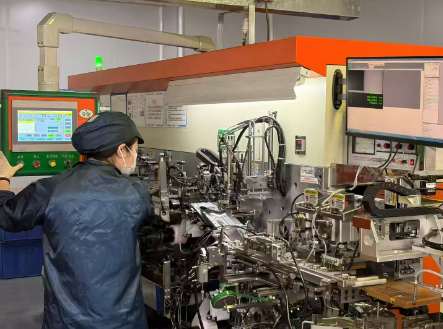
Because Li-MnO₂ pouch cells are a relatively specialised product, the market is full of traders reselling cells sourced from tier-2 factories. The symptoms of a substandard cell are familiar: higher-than-spec self-discharge (5–10% per year instead of 2%), early voltage sag under pulse current, and leaks at the edge seal after 12 months in storage. SERUI controls its own electrode coating, lamination and formation processes, which is why our customers routinely reorder 3,000–50,000 cells per quarter once qualification is complete.
Design-In Considerations and FAQ
7.1 How do I choose between CP223830 and other form factors?
If your device needs <1 mA average current (e.g. an RTC backup or a passive logger), a smaller cell such as CP124040 or CP012525 is more economical.
If you need 50–150 mA pulses (BLE, GPS, GSM), CP223830's 100 mA continuous / 150 mA pulse rating is the right starting point.
If you need >200 mA continuous, consider a Li-SOCl₂ cylindrical cell in parallel with a supercapacitor, rather than pushing a pouch cell beyond its rating.
7.2 Can I recharge a CP223830?
No. The CP223830 is a primary cell. Attempting to recharge it will cause venting, leakage and safety risk. If your application requires rechargeable power, look at our LiPo pouch range instead.
7.3 How long will a CP223830 last in my device?
As a rule of thumb, runtime = capacity / average current, derated by 20% for end-of-life. For example:
400 mAh ÷ 0.2 mA average = ~2,000 hours ≈ 83 days at 25 °C.
400 mAh ÷ 0.05 mA (50 µA) = ~8,000 hours ≈ 333 days ≈ 11 months.
For pulse-load applications, model the average current (sleep current + duty-cycled pulse current) rather than the peak.
7.3 What certifications do I need for my end product?
The cell itself is UL, UN38.3 and RoHS certified. For the end device, your regulatory team will typically need:
UN38.3 test summary for shipping.
IEC 62133 / UL 60950 for the final product safety evaluation.
CE / FCC / RoHS for market entry.
We provide all the cell-level documentation to support these filings.
7.5 What is the minimum order quantity (MOQ)?
Samples: 1–10 units, often free for qualified OEMs (customer pays freight).
Pilot run: 500–1,000 units.
Volume production: 3,000 units and up, with tiered pricing at 5K, 10K and 50K.
Conclusion: Power the Next Generation with an Ultra Thin LiMnO₂ Primary Pouch Cell
The shift from cylindrical and coin cells to ultra thin primary pouch cells is not a styling trend — it is an architectural change driven by the physical reality of wearables, medical patches and IoT labels. A product team that chooses the right LiMnO₂ battery today will ship on time, with a thinner enclosure, a longer shelf life and a happier end user.
The CP223830 — 3.0 V, 400 mAh, 2.4 mm thick, 3.8 g, rated to −40 °C / +60 °C and certified to UL / UN38.3 / RoHS — is a proven starting point for any design that needs reliable flat power. Whether you are building a smartwatch, a disposable ECG patch, an active RFID tag, a TPMS sensor or a GPS tracker, this cell can be qualified in weeks and scaled to production in months.
If you would like to evaluate the CP223830 for your product, or discuss a custom ultra thin LiMnO₂ pouch cell sized exactly to your enclosure, visit www.serui-battery.com or contact our engineering team directly. We routinely send free samples to qualified OEMs and can turn around a quotation within 24 hours.
Power thinner. Last longer. Design without compromise.
— The SERUI Team Guangzhou Serui Battery Technology Co., Ltd. www.serui-battery.com