LiSOCL2 Battery SPC1520 | ER14505+HPC1520 Hybrid Pulse Capacitor 3.6V 2500mAh
LiSOCL2 Battery SPC1520: The ER14505+HPC1520 Hybrid Pulse Capacitor Battery — 3.6V Supercapacitor Power for Smart Metering, AMR and IoT
Introduction
Modern smart devices present battery engineers with a contradiction. They need decades-class shelf life and tiny steady-state loads, yet every transmission — a meter reading, an alarm, a tracking ping — demands a sudden burst of current that ordinary long-life batteries struggle to deliver. The engineering answer is the hybrid pulse capacitor battery: a high-energy LiSOCL2 battery paired in parallel with a supercapacitor that handles the pulses. One of the most proven configurations in this class is the ER14505+SPC1520, a 3.6V, 2500mAh cylindrical power pack that combines a AA-size lithium thionyl chloride cell with a super pulse capacitor — often designated as the ER14505+HPC1520 or ER14505 SPC1520 composite pack.
This article explains what a LiSOCL2 battery SPC1520 hybrid pack is, why the capacitor is necessary, how the two components work together, and where this combination delivers the most value — from utility metering and automatic meter reading (AMR) to alarms, tollgate systems, automotive electronics, military equipment and wireless tracking.
What Is a Hybrid Pulse Capacitor Battery?
A hybrid pulse capacitor battery is not a new chemistry — it is a smart combination of two proven technologies. The energy source is a LiSOCL2 battery (lithium thionyl chloride, Li-SOCl₂), a primary cell famous for the highest energy density of any battery system, a 3.6V nominal rail, ultra-low self-discharge and a 10-year-plus storage life. The pulse source is a supercapacitor — a hybrid pulse capacitor that can charge almost instantly and dump large currents without suffering the passivation and voltage-delay effects that limit bare Li-SOCl2 cells under pulse loads.
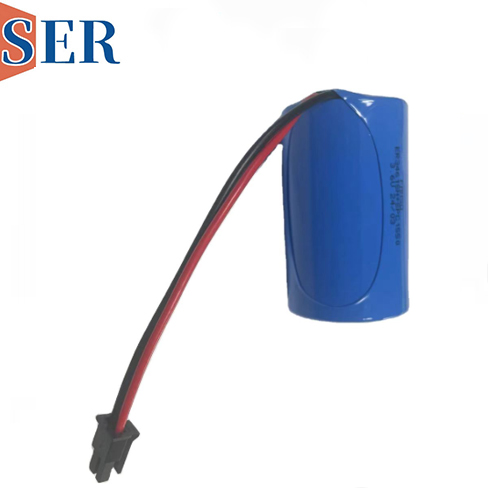
In the ER14505+SPC1520 pack, the AA-size (18 × 75mm overall) ER14505 Li-SOCl2 cell is assembled in parallel with the SPC1520 super capacitor inside a single cylindrical housing, delivered with pre-attached wire leads and a connector — typically an XH-2P red/black configuration — so the OEM can drop the pack directly into a PCB design. The result behaves like one battery with two personalities: long-life energy storage plus instant high-current delivery.
Why Li-SOCl2 Needs a Supercapacitor Partner
Li-SOCl2 cells are superb at delivering small, steady currents for years. Their limitation appears when the load demands a large pulse — for example, when a radio wakes up and transmits, or a valve actuator fires. Three effects make bare cells struggle:
Passivation. A thin film forms on the lithium anode during storage and light load. Under a sudden heavy pulse, this film can cause a transient voltage dip — the well-known "voltage delay" — before the cell recovers.
Rate limitation. Bobbin-construction Li-SOCl2 cells are optimized for energy density, not for high discharge rates. Sustained or repeated pulses at high current reduce the usable capacity and stress the cell.
System-level consequences. For a smart meter or alarm panel, a voltage sag at the moment of transmission can cause brownouts, resets or failed communication.
The SPC1520 supercapacitor eliminates these problems. Because the capacitor carries the high-pulse discharge, the Li-SOCl2 cell only sees a gentle average load — exactly the regime where it is strongest. The capacitor, in turn, has no voltage hysteresis and no passivation effect, so the output rail stays clean and stable even at the instant of a 2A-class pulse.
ER14505+SPC1520: Technical Specification
The ER14505+HPC1520 hybrid pack delivers performance that combines primary-cell energy with supercapacitor power:
表格
Model | Hybrid Pulse Capacitor Battery ER14505 + SPC1520 |
Voltage | 3.6V nominal |
Capacity | 2500mAh (23±2°C, 2.0mA / 2.0V cut-off) |
Open-circuit voltage | ≥3.64V |
Load voltage | ≥3.20V (8Ω, 20±5°C, ≤10s) |
Continuous working current | 1000mA (20±5°C) |
Large pulse working current | 2000mA (20±5°C) |
Operating temperature | -55°C to +85°C |
Shape / size | Cylindrical, 18 × 75mm |
Terminals | Wire leads with connector (e.g., XH-2P), customizable |
Storage life | 10 years |
Brand | SER or OEM |
Two numbers deserve attention. First, the 2500mAh capacity is rated at a realistic micro-drain (2.0mA) — the load a Li-SOCl2 cell actually sees in hybrid service, confirming that the capacitor does not "steal" energy from the battery. Second, the pack sustains 1000mA continuous and 2000mA pulse currents across a -55°C to +85°C window, which no bare AA-size Li-SOCl2 cell could deliver without sagging. This is the entire point of the hybrid architecture.
How the Hybrid Pack Works
The working principle of the 3.6V LiSOCL2 battery + SPC1520 composite pack is elegantly simple:
The Li-SOCl2 cell and the composite capacitor are connected in parallel. The battery acts as the energy-type element with high safety and long life; the capacitor acts as the power-type element.
All high-pulse discharge is handled by the capacitor, which has no voltage hysteresis and no passivation effect. The output voltage is therefore stable and immediately available when the load demands current.
Between pulses, the capacitor recharges fully from the battery. Once the capacitor is recharged, the pack's discharge capacity remains unchanged until the battery's energy is exhausted — the capacitor adds power capability without reducing the pack's total energy.
In practice, this means a smart meter or NB-IoT module can transmit thousands of times over a decade, with every pulse backed by a fully charged capacitor and every quiet hour slowly refilling the reservoir from a battery that is barely stressed. The battery keeps its 10-year life; the system gets instantaneous power.
Advantages of the Supercapacitor Element
The SPC1520 capacitor side of the hybrid brings a distinct set of advantages, proven in industrial practice:
Near-instant charge. The capacitor charges from the battery in seconds to minutes, reaching more than 95% of its rated capacity, so the pack is ready for the next pulse almost as soon as the last one ends.
High power, low loss. The capacitor can release large energy instantly, and because it is never deeply discharged as a system, the losses across the discharge cycle are small — the fast energy cycle is roughly five times more effective than a battery delivering the same pulses.
Wide temperature resilience. The hybrid pack operates continuously at high temperature (75°C class) and at ultra-low temperature (-40°C class), matching the -55°C to +85°C rating of the assembled pack.
Long cycle life, no memory effect. Capacitor elements support deep charge/discharge cycles in the range of hundreds of thousands of cycles with no "memory effect" — they do not wear out from repeated pulsing.
Green materials. The supercapacitor's raw materials are environmentally friendly, and its production does not generate harmful waste — an increasingly important criterion for OEM procurement.
Applications: Where the ER14505+SPC1520 Delivers
The ER14505+SPC1520 hybrid pulse capacitor battery is used wherever long life must be combined with bursty power demand:
Utility metering and automatic meter reading (AMR). Smart electricity, gas and water meters sleep for months and wake to transmit readings. The hybrid pack powers the metering electronics and the radio burst without voltage sag, over a service life that can exceed the meter's certification cycle.
Memory back-up and alarms. Security panels, alarm sensors and memory backup circuits need guaranteed power for years and instant energy for events. The stable 3.6V rail and the capacitor's instantaneous response make the pack a natural fit.
Wireless alarm and remote tracking systems. Tracking devices and remote monitoring systems transmit location and status at intervals. The 2000mA pulse capability supports GPS and cellular module bursts reliably, even from a small AA-size package.
Tollgate and electronic toll collection (ETC) systems. Roadside and in-vehicle units operate outdoors across temperature extremes and must respond instantly when a vehicle passes. The hybrid's wide temperature range and clean pulse output suit this duty.
Automotive and professional electronics. From tyre pressure sensors and telematics to professional instrumentation, designers need a power source that tolerates vibration, heat and cold while never failing a pulse.
Military equipment. Rugged military electronics value the combination of decade-class storage, wide temperature tolerance and dependable pulse performance — all available in a compact, OEM-configurable pack.
NB-IoT wireless modules. The page notes mature practical data for the 3.6V hybrid pack powering NB-IoT modules — one of the most demanding IoT loads, where narrowband radios draw high current during connection establishment and then return to microamp sleep. This is precisely the load profile the ER14505+SPC1520 was built for.
Why Choose SER as the OEM Partner
The ER14505+SPC1520 pack is available under the SER brand or under OEM private label. Guangzhou Ser Battery Technology Co., Ltd, founded in 2004, is a CE, UL, SGS, IEC and ISO9001 certified high-tech manufacturer with three production bases, 16 advanced manufacturing lines and more than 1650 staff, producing about 20,000,000 primary cells and 600,000 rechargeable packs per month. Beyond manufacturing scale, SER offers a full battery portfolio (LiSOCl2, LiMnO2, LiPo and LiFePO4), strong OEM/ODM engineering, strict IQC-to-OQC quality control in dust-free workshops, and fast delivery through long-term freight partnerships. For OEMs, this means the hybrid pack can be customized — leads, connectors, labeling and packaging — without compromising certification or consistency.
Conclusion
The ER14505+SPC1520 hybrid pulse capacitor battery solves a problem that has vexed smart device designers for years: how to get decade-class energy density and instantaneous high-current pulses from a single AA-size package. By pairing a 3.6V LiSOCL2 battery with a super pulse capacitor in parallel, the pack delivers 2500mAh of long-life energy and 2000mA of clean pulse current across -55°C to +85°C — with no voltage delay, no passivation penalty, and a 10-year storage life.
Whether the application is a smart meter, an AMR radio, a security panel, a tollgate system, an automotive sensor or an NB-IoT module, the LiSOCL2 battery SPC1520 architecture delivers the same promise: the battery stores the energy, the capacitor delivers the power, and the device simply works — for years.