ER34615 SPC1550 Battery: The High-Pulse LiSOCl2 Solution Behind NB-IoT Smart Meters and Long-Life Industrial Devices
ER34615 SPC1550 Battery: The High-Pulse LiSOCl2 Solution Behind NB-IoT Smart Meters and Long-Life Industrial Devices
Introduction
The connected world runs on devices that must work for a decade on a single, maintenance-free power source. Smart water meters, gas meters, NB-IoT wireless modules, tracking beacons and remote alarm systems are all expected to deliver precise data, wake for a short burst of radio transmission, and then return to deep sleep - for years on end, in temperatures that range from freezing winters to searing summer heat. This is one of the most demanding power challenges in industrial electronics, and it is exactly the problem the ER34615 SPC1550 LiSOCl2 battery was designed to solve.
Most of these devices do not simply draw a small, steady current. They sleep for almost their entire life, wake for a few seconds, and then demand a sudden high-current pulse to power a radio transmission, energize an actuator, or log a reading. Meeting both requirements at once - long shelf life and burst power - is notoriously difficult for a single battery chemistry.
The ER34615 SPC1550 offers a proven answer. By pairing a high-energy lithium thionyl chloride cell with a supercapacitor, this composite power source delivers the steady, decade-long background energy of a LiSOCl2 cell while providing the 5-amp pulse currents that NB-IoT and AMR (automatic meter reading) modules require. This article explains how this hybrid works, what makes it different, and why it is becoming the default choice for utility metering and wireless sensing applications around the world.
What Is the ER34615 SPC1550 Battery?
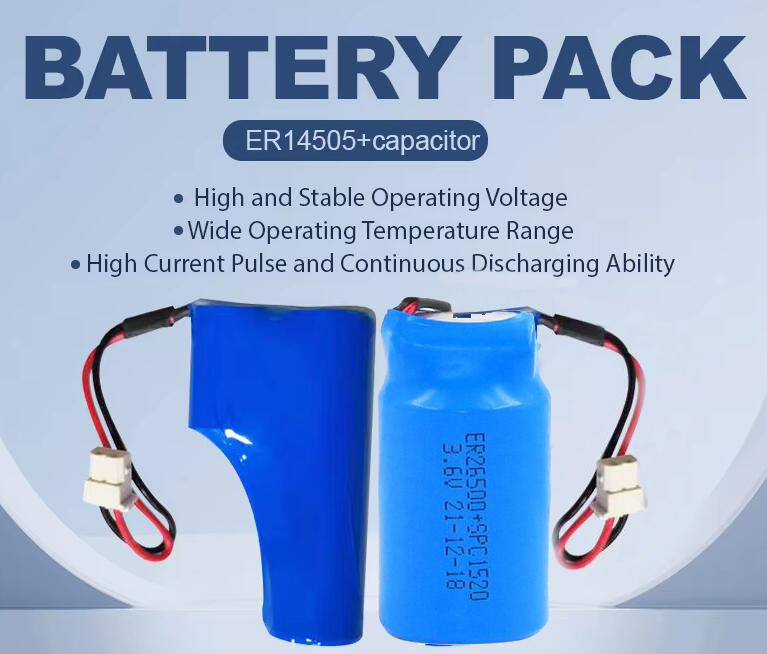
The ER34615 SPC1550 is a composite power source that combines two elements in a single battery pack. The first element is an ER34615 lithium thionyl chloride (LiSOCl2) cell - a D-size, high-energy primary cell rated at 3.6 V with a nominal capacity of 19 Ah. The second element is a supercapacitor connected in parallel with the cell. Depending on the manufacturer, the capacitor grade may be branded as SPC1550, SPC1520, EPC1550, EPC1520, UPC1550, HPC1550, SLC1550 or RHC1550, but the operating principle is the same.
The two components work together to get the best of both worlds. The LiSOCl2 cell is the energy reservoir. It supplies the long-term background current that keeps the device alive and keeps the supercapacitor charged. The supercapacitor is the power reservoir. It handles the sharp, high-current pulses that would otherwise damage a conventional cell, cause a voltage drop, or prematurely deplete the battery. Because the two components are connected in parallel, the device always sees the full voltage of the pack while drawing its steady current from the cell and its bursts from the capacitor.
Why LiSOCl2 Battery Chemistry?
To understand why the ER34615 SPC1550 is engineered this way, it helps to understand why engineers choose lithium thionyl chloride cells in the first place. The LiSOCl2 battery is widely regarded as the highest-energy-density primary lithium chemistry commercially available. For designers of remote, battery-powered equipment, it offers a combination of attributes that are very difficult to match from any other chemistry:
First, it delivers the highest energy density of any primary lithium cell, which means more capacity in the same physical size. Second, it provides a high and stable operating voltage of 3.6 V throughout most of its discharge. Third, it has an extremely low self-discharge rate - typically well under 1% per year at room temperature - which is what allows the battery to be stored and used for a decade. Fourth, it offers a wide operating temperature range, from roughly -55 degrees C to +85 degrees C, so it can be installed in meter pits, outdoor enclosures and industrial sites where temperatures vary dramatically. Finally, because of its low self-discharge and robust construction, a LiSOCl2 cell can deliver a service life of 10 years or more.
Because a LiSOCl2 cell can sit on a shelf, or inside a buried meter, for a decade and still deliver usable energy, it is the natural choice for applications where replacing a battery is impractical or expensive. The trade-off has always been power delivery. LiSOCl2 cells are energy-optimized, not power-optimized. Under a very high sustained or pulsed load, their voltage can sag. They can also be affected by a phenomenon known as passivation - a thin film that forms on the lithium anode during storage or low-load operation. When a high current is suddenly demanded, this film causes a temporary voltage dip. In a device that must fire a radio burst precisely on schedule, that voltage dip can mean a missed transmission, a lost reading, or an unwanted reset.
Why the D-Size, 3.6V 19Ah Format Matters
The ER34615 is a D-size cylindrical cell, and the physical format is part of the value proposition. In utility metering and industrial IoT, there is rarely space to spare, yet the energy budget is large. A D-size cell strikes a practical balance: it is compact enough to fit inside standard meter housings and remote radio units, while large enough to hold the 19 Ah of capacity that a decade-long duty cycle requires.
The 3.6 V nominal voltage is another deliberate choice. Many wireless modules, sensors and memory circuits are designed around a nominal 3 V to 3.6 V rail, and the LiSOCl2 chemistry holds its voltage high and stable across most of its discharge. That stability matters for two reasons. First, it means the electronics can run closer to their design voltage for longer, so the usable life of the pack is high relative to its rated capacity. Second, because the voltage does not sag under pulse load - thanks to the parallel supercapacitor - the module is less likely to hit an undervoltage threshold and drop a transmission. In short, the 3.6 V 19 Ah D-size format is not arbitrary; it is tuned to the real needs of long-life wireless devices.
Safety and Handling of LiSOCl2 Batteries
Because LiSOCl2 cells use a highly reactive chemistry, correct handling and protection are essential, and this is an area where a qualified supplier adds real value. The ER34615 SPC1550 pack is a primary (non-rechargeable) cell: it is designed to be discharged once and then replaced, and it must never be charged. Charging a lithium thionyl chloride cell can cause dangerous reactions, so every pack is clearly marked and the associated electronics should be designed to prevent any possibility of charging.
In practice, safe design means a few basic measures. The battery should be protected against short-circuit, overload, over-discharge and reverse current, which is why SER incorporates protection against undervoltage, short-circuit, overload and backflow in its packs. The battery should be stored and operated within its rated temperature range, and disposed of according to the regulations that apply to lithium batteries in the customer’s market. For export applications, the pack must also comply with the transport regulations governing lithium batteries by air, sea and road. A supplier that holds CE, UL, SGS and IEC certifications, and that understands international shipping, helps the customer manage these compliance requirements from design through delivery.
The Supercapacitor Fix: How the ER34615 SPC1550 Works
This is where the supercapacitor changes everything. In the ER34615 SPC1550 composite power source, the supercapacitor is connected in parallel with the LiSOCl2 cell, and the two share the workload in a simple, reliable cycle.
During standby, the LiSOCl2 cell slowly charges the supercapacitor while delivering the small background current the device needs to stay alive. When the device demands a high pulse - for example, when an NB-IoT module wakes and transmits data - the supercapacitor supplies the burst almost instantly. Because the capacitor has no passivation effect and no voltage hysteresis, the voltage stays high and stable throughout the pulse, even at the moment of peak demand.
Once the pulse ends, the cell recharges the capacitor, and the cycle repeats. Because the capacitor is fully recharged before the next pulse arrives, the discharge capacity of the pack remains unchanged until the cell energy is genuinely exhausted. In other words, the composite pack keeps delivering its full rated capacity pulse after pulse, rather than degrading with each burst. The result is a power source that behaves like an energy cell with the muscle of a power cell: it can deliver pulse currents of up to 5 A while retaining the long life and high energy of the underlying LiSOCl2 cell.
Key Specifications of the ER34615 SPC1550
For engineers evaluating the ER34615 SPC1550, the key performance figures are summarised below. These values are drawn from the manufacturer’s published product data.
Parameter | Value |
Nominal voltage | 3.6 V |
Nominal capacity | 19 Ah (measured at 23 ± 2 °C, 5.0 mA discharge to 2.0 V) |
Open-circuit voltage | ≥ 3.64 V |
Load voltage | ≥ 3.20 V (8 Ω load, 20 ± 5 °C, ≤ 10 s) |
Continuous working current | Up to 2000 mA (at 20 ± 5 °C) |
Large pulse working current | 5 A |
Operating temperature range | -55 °C to +85 °C |
Storage life | 10 years |
The battery also uses a stainless-steel housing and electrode cap with low magnetic characteristics. This is an important detail for applications that are sensitive to magnetism, such as certain metering equipment and medical or military electronics, where a ferromagnetic component could interfere with nearby circuits or sensors.
Performance Characteristics
Several performance curves define how the ER34615 SPC1550 behaves in the real world, and understanding them helps a designer predict battery life accurately.
Self-discharge vs. temperature: The annual capacity loss of the LiSOCl2 cell rises as temperature increases. At typical operating temperatures the self-discharge is very low, which is what enables the long service life. Designers should account for ambient temperature when estimating battery life, since a meter installed in a hot enclosure will lose capacity slightly faster than one kept at room temperature.
Capacity vs. current: The delivered capacity of the cell depends on the discharge current and the temperature. Under low, intermittent loads the cell delivers close to its full rated capacity; under higher loads, the delivered capacity decreases. This is precisely why pairing the cell with a supercapacitor matters - it lets the system draw high currents without drawing them directly from the cell, preserving the energy that a purely cell-driven design would lose.
Pulse performance: The composite pack maintains a high minimum voltage during one-second pulses, and the maximum pulse width that keeps the voltage above the module’s minimum threshold depends on temperature and load. In practice this means the ER34615 SPC1550 can reliably support the bursty load profiles of modern wireless modules even at low temperatures, where a bare LiSOCl2 cell would struggle to hold the required voltage.
Why NB-IoT and Smart Meters Need This Battery
The single most important application for the ER34615 SPC1550 is the NB-IoT wireless module. NB-IoT, or Narrowband Internet of Things, is the low-power, wide-area network technology used by smart water meters, gas meters and a wide range of industrial sensors. An NB-IoT device typically spends almost all of its life in a deep-sleep state, drawing only microamps, and then wakes periodically to take a measurement and transmit a short data packet over the cellular network.
The transmission burst is the problem. A cellular modem can demand a current spike of one amp or more for a fraction of a second - far more than a LiSOCl2 cell alone can deliver without a significant voltage drop. If the voltage falls below the modem’s minimum operating threshold, the transmission fails, data is lost, and the device may need to retry. Every retry wastes energy and shortens battery life, which is exactly what a utility wants to avoid in a meter that is expected to run for a decade unattended.
The ER34615 SPC1550 solves this cleanly. The supercapacitor absorbs the transmission burst and keeps the voltage steady, while the LiSOCl2 cell provides the long-term energy. This is why the ER34615 SPC1550 - and its companion variants such as the ER34615 SPC1520 - is increasingly specified for NB-IoT smart water meters and gas meters. SER has mature, practical application data for using the ER34615+SLC1550 combination with NB-IoT wireless modules, giving design teams confidence that the solution has been proven in the field rather than existing only on paper.
Applications Beyond Smart Meters
While smart metering is the headline use case, the ER34615 SPC1550 suits any application that needs long life combined with high-pulse capability:
Smart instrumentation and AMR: Water, gas, heat and electricity meters, plus automatic meter reading systems, benefit directly from a power source that lasts the life of the meter.
Memory and backup power: Wireless alarms, remote tracking and monitoring systems need a reliable source of backup power that can survive for years between maintenance visits.
Electronic toll collection: ETC systems require reliable, high-current pulses to power transponders and communication modules in roadside and in-vehicle equipment.
Military and automotive electronics: Rugged, wide-temperature power sources are required for defence equipment and automotive electronics, where reliability in extreme conditions is non-negotiable.
Professional and tracking electronics: Tracking devices, telematics and professional instrumentation all share the same profile - long standby life punctuated by brief high-current bursts.
In each of these, the same principle applies: a device that must stay alive for years but periodically needs a burst of power is a perfect fit for a LiSOCl2-plus-supercapacitor composite battery.
Choosing the Right Variant: SPC1550 vs. SPC1520
The ER34615 cell can be combined with several capacitor grades, and the naming can vary between manufacturers. Common pairings include ER34615+SPC1550, ER34615+SPC1520, and equivalents using EPC, UPC, HPC, SLC or RHC prefixes. The differences usually come down to the capacitor’s capacitance and rated current, which should be matched to the device’s pulse profile.
As a general rule, the designer should match the capacitor to the highest pulse current and the longest pulse duration the device will draw, while leaving headroom for temperature derating. A supplier with deep application experience, such as SER, can help select the correct grade and validate the combination against a specific load profile, so that the chosen pack is neither oversized nor undersized for the application.
Why Choose SER as the Supplier?
The ER34615 SPC1550 battery is manufactured by SER (Guangzhou Ser Battery Technology Co., Ltd), a company founded in 2004 that has focused on the lithium battery industry for nearly two decades. Choosing the right supplier matters for a power source that must last a decade, and SER brings several strengths to the table.
In terms of capacity, SER operates three producing bases with sixteen advanced manufacturing lines and more than 1,650 staff, enabling monthly production of approximately 20,000,000 primary cells and 600,000 rechargeable battery packs. This scale supports both stable supply and consistent quality. In terms of certification, SER holds CE, UL, SGS, IEC and ISO9001 certification and is recognised as a high-tech company, giving customers documented assurance of compliance and reliability.
SER also offers a full product range that extends beyond LiSOCl2 cells to include LiMnO2 batteries, lithium polymer (LiPO) batteries and LiFePO4 batteries. A design team can therefore source multiple chemistries from a single partner instead of managing several vendors. On the engineering side, professional engineers with deep OEM and ODM experience can support a customer from product design and battery solution through to mass production, reducing both time cost and communication cost. Throughout, strict controls from IQC to IPQC to OQC, protection against undervoltage, short-circuit, overload and backflow, and rigorous inspection and external testing help ensure that no quality problems reach the customer. Finally, a dedicated sales, shipping and after-sales team, working with long-term cooperative freight companies and stable routes, supports fast delivery and timely service.
Design-In Tips for Engineers
If you are evaluating the ER34615 SPC1550 for a new design, a few practical points will help you get it right the first time.
First, model your load profile before choosing the cell. Measure or estimate the standby current, the pulse current and the pulse duration, including the worst-case operating temperature. Second, match the capacitor grade to the pulse. Select a supercapacitor - SPC1550, SPC1520 or equivalent - whose rated pulse capability exceeds your peak demand, with margin for temperature derating. Third, account for temperature across the full operating range. Low temperatures reduce both capacity and pulse capability, so verify that the pack’s minimum voltage stays above your module’s threshold in the coldest case. Fourth, validate the combined pack. Use the manufacturer’s application data and, ideally, test the full pack under your actual radio burst pattern to confirm real-world behaviour. Fifth, plan for certification and compliance, ensuring the pack meets the safety and transport regulations that apply to lithium batteries for your target market.
SER’s engineers work directly with customers from product design to battery solution and mass production, helping to reduce time cost and communication cost while delivering a pack that is engineered for the specific application.
Conclusion
The ER34615 SPC1550 is more than a battery - it is a complete power architecture for the connected devices of the next decade. By combining the unmatched energy density of a LiSOCl2 cell with the instantaneous power of a supercapacitor, it delivers the long life that utility metering and industrial IoT demand, together with the 5 A pulse capability that modern wireless modules require.
Whether you are building an NB-IoT smart water meter, an electronic toll collection system, a tracking device or a wireless alarm, the ER34615 SPC1550 offers a reliable, field-proven solution. With its high energy density, low self-discharge, 10-year storage life and wide operating temperature range, it is engineered to be installed once and forgotten - which is exactly what a truly connected world needs.
If you are evaluating a LiSOCl2 battery for your next design, contact SER to discuss the ER34615 SPC1550, request a specification sheet, or explore a custom configuration for your application.