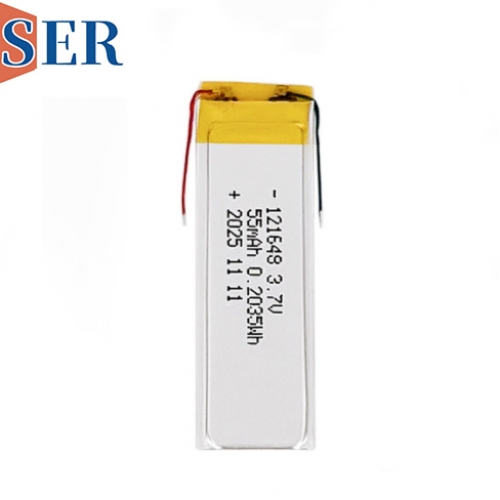
Li-MnO2 Pouch Cell Explained: Inside the CP601420 3V 240mAh Ultra Thin Battery
Li-MnO2 Pouch Cell Explained: Inside the CP601420 3V 240mAh Ultra Thin Battery
Hardware teams usually choose the radio, the sensor and the enclosure, then spend the last week of the schedule hunting for a battery that fits the space left over. That order is backwards. In a tag that has to survive a warehouse, a shipping container and a winter on a construction site, the power source decides how thin the product can be, how often it can report, and whether it ships at all.
This guide covers one practical answer: the Li-MnO2 pouch cell, and the CP601420 3V 240mAh ultra thin battery in particular. It walks through the chemistry, what a pouch construction gives you that a coin cell cannot, how to read CP part numbers, where the cell fits in IoT, outdoor asset tracking and LoRa tags, and what decides whether you get three years of service or eight months.
Why the Power Source Decides the Product
Rechargeable lithium-ion is out for most tracking devices: someone has to plug them in, and energy harvesting looks elegant on a datasheet but fails in a warehouse aisle with no light. That leaves primary lithium cells, and the choice within that family comes down to three questions. Can the cell deliver the radio's current pulses without collapsing? Can it sit on a shelf for two years and still work on day one? Can it be thin and rectangular enough to disappear inside the product? The LiMnO2 battery answers all three, which is why the format has become the default for labels, tags, beacons and sealed sensors.
What Is a Li-MnO2 Pouch Cell?
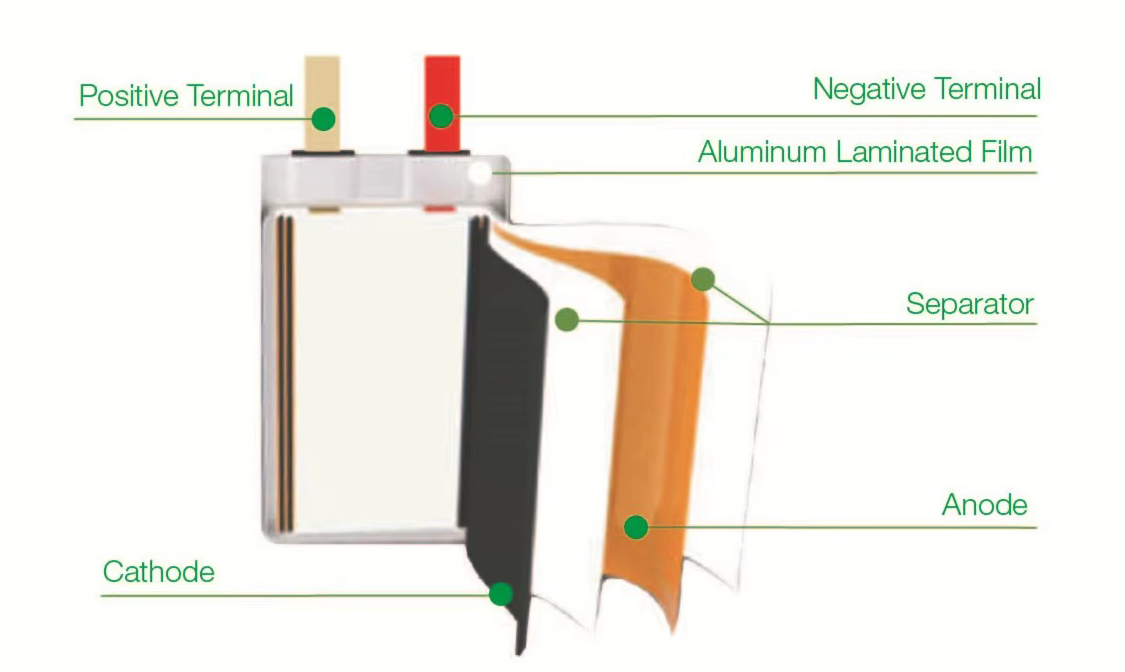
A Li-MnO2 pouch cell is a primary lithium battery in which a lithium metal anode and a heat-treated manganese dioxide cathode are sealed inside a laminated aluminium film bag rather than a metal can. The pouch is the enclosure; Li-MnO2 is the electrochemistry. Together they produce a flat, rectangular 3V cell that can be built in almost any footprint.
The chemistry, briefly
Both electrodes can be coated and laminated as flat layers, which is what makes the format possible:
Anode: lithium metal foil, the lightest practical anode material and the source of the high energy density.
Cathode: manganese dioxide, heat-treated to drive off moisture, then mixed with conductive carbon and a binder and coated onto an aluminium current collector.
Separator: a microporous polyolefin film that keeps the electrodes apart while letting lithium ions through.
Electrolyte: a lithium salt such as lithium perchlorate in an organic solvent system.
On discharge, lithium gives up an electron and the resulting Li+ ion travels through the separator and intercalates into the MnO2 lattice. The reaction runs at a stable potential, produces no gas and needs no maintenance. Because the anode is consumed rather than cycled, the cell is non-rechargeable — recharging would plate lithium dendrites and risk an internal short. A LiMnO2 battery must never be charged.
Why the discharge curve is flat
A Li-MnO2 discharge plot looks like a shelf, not a slope. Under a light continuous load, voltage holds close to 3.0V for most of the delivered capacity, then falls away below roughly 2.5V and should be cut off at about 2.0V.
That plateau solves two problems at once. Most 3V logic and 3.3V-rated microcontrollers and radios run close to end of life without a boost converter, so you avoid the quiescent current a regulator burns continuously. And voltage becomes a usable state-of-charge signal, because the tail of the curve is steep enough that 3.0V and 2.6V mean genuinely different things.
Inside a Pouch Cell: Layers, Tabs and Laminate Film
A pouch cell is built as a stack. Cathode, separator and anode are laminated or wound into a flat core, saturated with electrolyte, and dropped into a pocket formed from laminated film: an outer protective polymer, a thin aluminium barrier layer, and an inner heat-sealable layer. Heat sealing closes the perimeter and creates the gas-tight barrier that keeps moisture out and electrolyte in.
Two metal tabs exit the seal. The positive tab is aluminium, the negative tab is nickel or nickel-plated, since bare copper would alloy with lithium. On a finished CP601420 those tabs are spot-welded to insulated wire leads so the cell can be plugged into a board or connector rather than soldered directly.
What the construction buys you:
Thickness set by the stack, not by a can. Laminated film is around a tenth of a millimetre, so cell thickness tracks the electrode stack.
Rectangular footprint. Pouch cells fill a rectangle; coin and cylindrical cells waste the corners. In a flat product that can be worth a third of the usable volume.
Shape flexibility. Non-standard footprints are routine, because there is no metal shell to tool.
A gentler failure mode. A pressurised metal can vents violently. A pouch swells.
The trade-offs drive most of the mechanical advice below. A pouch cell has no structural rigidity of its own, so the enclosure must protect it, and the heat seal is the weak point: bend it, puncture it or crush it and the cell is scrap. There are also no through-hole pins, which is why CP601420 ships with wire leads.
What "Ultra Thin Battery" Actually Means
The term ultra thin battery gets applied to everything from a 2mm prismatic cell to a 0.4mm flexible laminate. In practice, thinness is defined by the product rather than the datasheet:
Under 2mm: the cell sits under a PCB or inside a thin wall without a visible bump.
Under 1mm: it can be laminated into a label, inlay or card body alongside other layers.
Under 0.5mm: it bends with the substrate, typically at capacities of tens of milliamp-hours rather than hundreds.
Li-MnO2 is the chemistry that made the lower end practical, for the same reason it works at all: both electrodes are flat layers and the enclosure is film.
At roughly 6.0mm thick, the CP601420 is not the thinnest cell available. It is an ultra thin battery in the sense that matters for its class: 240mAh of capacity from a 6mm profile and a footprint smaller than a stamp. The same chemistry reaches down to 0.4mm to 1mm when you only need 15mAh to 40mAh, so size the cell to the energy budget first, then pick the thinnest package that budget allows.
Reading a CP part number
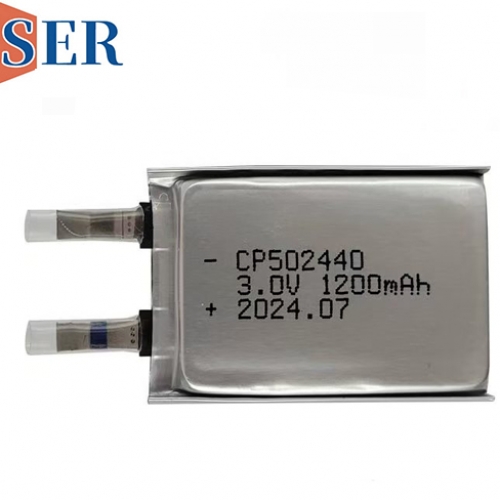
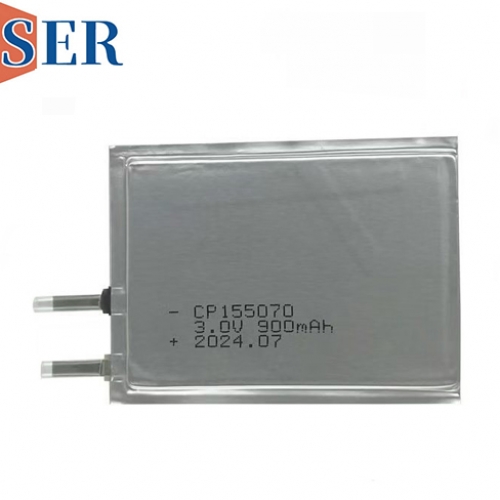
The model number of a Li-MnO2 pouch cell is effectively a dimension drawing: CP + thickness + width + length, with the first two digits expressing thickness in tenths of a millimetre. CP601420 therefore decodes as 6.0mm thick, 14mm wide and 20mm long. CP502540 is 5.0mm × 25mm × 40mm; CP042527 is a 0.45mm cell measuring 25mm by 27mm. That lets you eliminate options on mechanical fit before opening a catalogue — but confirm the width/length order against the supplier's outline drawing, since conventions vary between manufacturers.
CP601420: A 3V 240mAh Ultra Thin Battery for Embedded IoT
CP601420 is a Li-MnO2 primary pouch cell rated at 3V and 240mAh, supplied with wire leads and available for OEM programmes. It targets the middle of the IoT range: devices that need more capacity than a coin cell, more pulse current than a thin-film cell, and a rectangular package that fits a slim enclosure.
Parameter | CP601420 |
|---|---|
Chemistry | Li-MnO2 (lithium manganese dioxide), primary |
Nominal voltage / OCV | 3.0 V / ≥3.0 V at 25 °C (typically 3.1–3.3 V) |
Nominal capacity | 240 mAh |
Cutoff voltage | 2.0 V |
Format | Rectangular pouch, laminated aluminium film |
Nominal dimensions | approx. 6.0 mm × 14 mm × 20 mm |
Approximate weight | ~2.5–3 g |
Standard discharge current | ~1 mA |
Operating temperature | −20 °C to +60 °C (wider ranges available) |
Self-discharge | under 1–2% per year at 25 °C |
Storage life | up to 10 years under recommended conditions |
Termination | insulated wire leads; length and connector to order |
Rechargeable | No |
Capacities are quoted at 25 °C under a light continuous load to a 2.0V cutoff, and will be lower at high current, low temperature or against a higher cutoff. Maximum continuous and pulse current ratings depend on the acceptable voltage sag, so confirm current limits for your production version against the cell datasheet rather than a catalogue summary.
What 240mAh actually buys you
At 3.0V nominal, 240mAh is 0.72Wh. For a cell of roughly 1.7cm³ weighing under 3g, that is a volumetric energy density in the region of 400–430Wh/L and a gravimetric density around 250–270Wh/kg — competitive for a primary system, and achieved without the packaging overhead of a metal can.
The arithmetic matters more than the density figure. Take a LoRa sensor tag that sleeps at 5µA, wakes every 15 minutes and transmits for 80ms at 40mA:
Energy per transmission: 40mA × 0.08s ≈ 0.0009mAh
Average current: 5µA sleep + ~3.6µA transmit ≈ 8.6µA
Expected life from 240mAh: about 3 years
Now add a GNSS receiver needing a 25-second fix at 30mA every four hours. GNSS costs about 0.21mAh per cycle against roughly 0.02mAh for sleep and radio, which pushes average current to about 58µA and drops expected life to 5 to 6 months.
Positioning, not transmission, dominates the energy budget in a tracking device. The CP601420 suits devices that report infrequently or rely on network-side localisation instead of a GNSS fix on every cycle. If you need hourly GNSS, specify a larger cell in the same family rather than shaving sleep current.
Performance You Can Design Around
Self-discharge. Li-MnO2 pouch cells typically self-discharge at under 1–2% per year at room temperature, better than alkaline by a wide margin. A tag that sat in a warehouse for 18 months still has more than 97% of its capacity, which matters more than a marginal density advantage for products with long distribution chains.
Temperature. The standard window is −20 °C to +60 °C, with wide-temperature variants reaching −40 °C to +70 °C. At low temperature, internal resistance rises, so the same transmit pulse produces a deeper voltage sag — exactly the condition under which a marginal design browns out and drops packets. At high temperature, self-discharge and storage degradation accelerate, so validate a dashboard-mounted device in its real thermal environment rather than at 25 °C in a lab.
Safety and sealing. Li-MnO2 is one of the safer primary lithium chemistries: manganese dioxide is thermally stable, there is no pressurised metal shell, and pouch failures present as swelling rather than rupture. Finished cells are typically qualified to IEC 60086-4 for primary lithium safety and UN38.3 for transport, with UL, RoHS and REACH documentation available depending on the programme.
Where Li-MnO2 Pouch Cells Win: IoT Devices
The IoT products that end up with a pouch cell share a pattern. They are sealed, deployed in volume, impossible to service, and getting thinner with every hardware revision. Smart meters and telemetry units need a decade of unattended operation. Electronic shelf labels and smart cards push the cell into its thinnest variants, because it has to vanish into a card body alongside a display or antenna. Smoke detectors, door contacts, leak sensors, patch sensors and active RFID tags all sleep most of their life and need a dependable pulse when an event occurs.
None of these products can afford a battery holder, a service hatch or a charging port. The cell becomes a component on the bill of materials, not an accessory.
Outdoor Asset Tracking: The Battery Behind the Tag
Outdoor tracking is a harsher specification than indoor IoT, and it exposes weaknesses a heated lab never will.
Temperature cycling. A trailer-mounted tag can see −15 °C at night and 60 °C in direct summer sun. Both ends are in scope for a Li-MnO2 pouch cell, but pulse behaviour at the cold end has to be verified with the real radio.
Vibration and shock. Containers, forklifts and rail yards are mechanical environments. Restrain the cell so it cannot move inside the enclosure, and give the leads strain relief so vibration does not fatigue the tab weld.
Shelf time before deployment. Assets may sit for a year or two before a tracker is attached. Low self-discharge and the absence of any passivation effect — the voltage delay that plagues lithium thionyl chloride cells after long storage — mean the tag works on its first transmit attempt.
Thin form factor. Tags are increasingly built as stickers, cable ties or slim pucks. A 6mm pouch cell with a small rectangular footprint fits a housing a coin-cell holder never would, with no metal clip adding height and cost.
LoRa Tags: Matching the Battery to the Pulse Profile
LoRa and LoRaWAN suit these cells, because the radio's current profile fits a primary lithium pouch — with one design detail that is easy to get wrong.
A LoRa tag spends almost all its life in deep sleep at single-digit microamps. Then it wakes, acquires a position or reads a sensor, and transmits. The burst is short but current-hungry:
Mode | Typical current |
|---|---|
Deep sleep | 5–20 µA |
Sensor / MCU active | 1–10 mA |
GNSS acquisition | 25–35 mA |
LoRa uplink transmission | 30–130 mA (higher at maximum output power) |
A coin cell with tens of ohms of internal resistance cannot supply a 100mA burst without its terminal voltage collapsing, which produces dropped packets and wasted energy. That is why coin-cell LoRa designs end up adding large capacitors and complex power management, and why the tag gets thicker anyway.
A Li-MnO2 pouch cell of this size has markedly lower internal resistance and handles the burst far better. It is still a primary cell with a finite pulse rating, so if your firmware transmits at maximum power with a short preamble, a buffer capacitor across the terminals is cheap insurance: 100µF to 470µF close to the radio will hold the rail up during the burst.
Two firmware decisions matter more than the cell choice. The reporting interval drives everything — going from every 15 minutes to every hour roughly quadruples service life. And LoRaWAN's Class A duty cycle already encourages infrequent uplinks, so designing around it rather than fighting it is the cheapest lifetime extension available.
Li-MnO2 Pouch vs Coin Cell, Li-SOCl2 and Alkaline
Li-MnO2 pouch | CR2032 coin | Li-SOCl2 (ER) | Alkaline | |
|---|---|---|---|---|
Nominal voltage | 3.0 V | 3.0 V | 3.6 V | 1.5 V |
Capacity in tag sizes | 240 mAh (CP601420) | 220 mAh | 2,600 mAh (AA) | 2,800 mAh (AA) |
Energy density | ~250–270 Wh/kg | ~200 Wh/kg | ~500–700 Wh/kg | ~110 Wh/kg |
Pulse capability | Good; supports radio bursts | Poor without buffering | Poor without a hybrid capacitor | Moderate |
Self-discharge | <1–2% / year | ~1–2% / year | <1% / year | 2–3% / year, degrades in storage |
Operating temperature | −20 to +60 °C (to −40/+70 °C) | −20 to +60 °C | −55 to +85 °C | −10 to +50 °C |
Voltage delay after storage | None | None | Yes, passivation | None |
Format | Flat, rectangular, customisable | Fixed 20mm disc | Cylindrical | Cylindrical |
Regulation for 3.3V logic | None | None | Often, 3.65 V OCV exceeds some ratings | Boost converter |
Li-SOCl2 wins on raw energy density and extreme temperature, but pays for it with passivation and a pulse problem that forces a hybrid layer capacitor into the design. Alkaline is cheap and unsuitable: leak risk, poor low-temperature behaviour, and a 1.5V rail that needs boosting. A coin cell is fine for a beacon that chirps a few milliamps once an hour, and wrong for anything with a real radio. The Li-MnO2 pouch cell takes the middle ground deliberately, trading some energy density for a pulse-friendly, passivation-free 3.0V cell that matches 3.3V logic directly.
Designing CP601420 Into Your Device
Most field failures with pouch cells are mechanical, not electrochemical.
Termination. The cell ships with insulated leads, typically around 26AWG in red and black, with length and connector to order. Route them with a service loop and anchor them to the board or housing within a few millimetres of the exit, so pull is taken by the anchor rather than the tab weld, and specify connectors at the ordering stage.
Keep heat away from the tabs. Direct, prolonged soldering to a pouch tab is the fastest way to destroy a cell, which is why tab-to-lead welding happens at the factory. Where a customer-side joint is unavoidable, use a hot iron with a heat sink between the joint and the cell body, keep contact time short, and never solder under mechanical tension.
Support the cell, not the seal. Do not bend, clamp or use the heat-sealed perimeter as a mounting flange. Adhesive foam or a moulded pocket supporting the flat faces is correct, with roughly half a millimetre of clearance for normal swell.
Size the buffer capacitor from the cold end, using the worst-case burst at the lowest specified temperature rather than room-temperature measurements.
Design out the charging path. No CP-series cell is rechargeable, so if the product has a USB port for configuration, make it impossible for firmware or a user to push current into the cell. Store cells in original packaging at moderate temperature and low humidity, and observe first-in-first-out.
OEM Supply, Customisation and Certifications
Because no metal tooling dictates its shape, customisation is one of the format's main commercial advantages. Capacity can be adjusted within a similar package by changing electrode area, so a range of capacities can be built around one mechanical outline — the CP601420 sits in a family running from tens of milliamp-hours to several thousand. Lead length, gauge and connector can be specified from bare tinned ends to a particular JST or Molex housing with defined colour coding and polarity. Labels can carry a part number, batch code, polarity marking and customer artwork.
The documentation pack typically includes a datasheet, outline drawing, MSDS, UN38.3 test summary, IEC 60086-4 safety report and RoHS/REACH declarations. Commercial terms are usually a modest minimum order quantity per configuration and sample lead times of days to a couple of weeks. If the design is still fluid, prototype against a catalogue cell and lock the footprint before committing to a custom size.
Frequently Asked Questions
Is the CP601420 rechargeable?No. It is a primary Li-MnO2 cell and must not be charged, reverse-charged or force-discharged.
Can I drop it into a design that uses a CR2032?The voltage is the same so the electronics usually work, but the mechanical approach differs — no holder, no solderable pins — and the pulse performance is much better, which may let you remove buffer capacitors.
Do I need a capacitor for LoRa transmissions?Not always, but it is the cheapest way to guarantee stability. A 100µF to 470µF capacitor close to the radio covers most LoRa burst profiles at low temperature.
What happens at −20 °C?The cell still delivers energy, but internal resistance rises and voltage sags more under load. Validate the complete product — firmware, radio and cell — at the lowest temperature the device will see.
Does it need a regulator for a 3.3V circuit?Usually not. A 3.0V nominal Li-MnO2 cell sits inside the supply range of most 3.3V-rated components, which is a practical advantage over a 3.6V lithium thionyl chloride cell.
The Short Version
Choose the power source before the enclosure, not after it.
The Li-MnO2 pouch cell exists because someone wanted a flat, sealed 3V cell with enough pulse capability to run a radio and enough shelf life to survive two years of logistics. The CP601420 delivers 240mAh in a package around 6.0mm × 14mm × 20mm with wire leads, and it is happiest in devices that report on a sensible interval without a GNSS fix on every cycle. Size it with the energy budget, protect the seal and the leads, buffer the transmit burst, and it will quietly do its job for years.
For IoT devices, outdoor asset tracking and LoRa tags in particular, the format solves a problem that coin cells and thionyl chloride cells only work around.