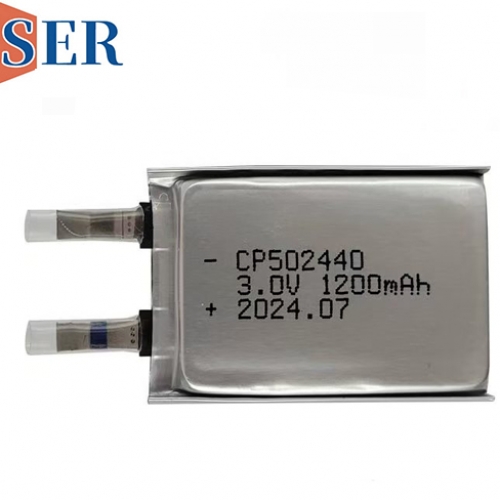
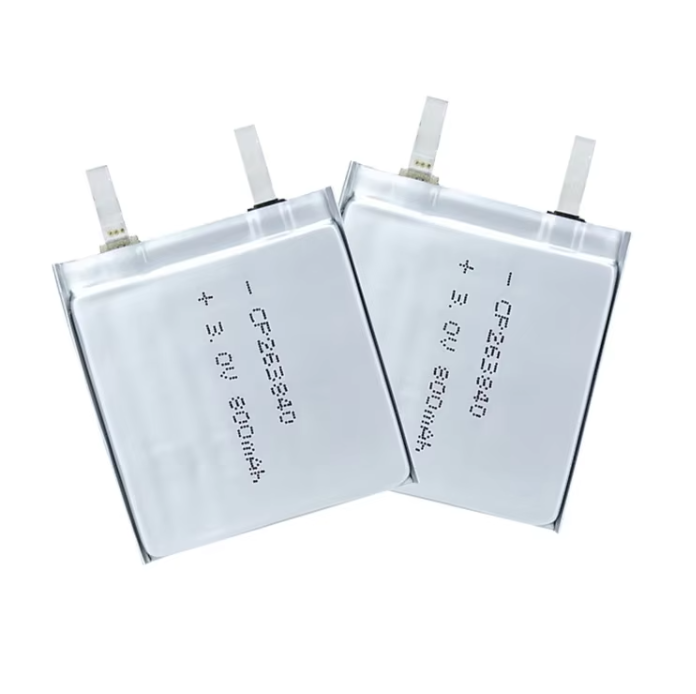
CP502440 LiMnO2 Battery | 3.0V 1200mAh Ultra Thin Soft Pack Battery for IoT
CP502440 LiMnO2 Soft Pack Battery: A 3.0V Ultra Thin Power Source for IoT, RFID and Tracking Devices
Introduction
When an IoT sensor, an RFID tag, a GPS tracker or a smart card must run for years inside a slim enclosure with almost no user maintenance, the energy source becomes the deciding factor between a reliable product and a field failure. The CP502440 LiMnO2 soft pack battery from SER is designed precisely for this kind of long-life, space-constrained deployment. Delivering a stable 3.0V nominal voltage and 1200mAh capacity in an ultra-thin 5×24×40mm pouch, this LiMnO2 battery combines high energy density, an extremely low self-discharge rate, immediate power delivery and a flat, flexible form factor that rigid coin or cylindrical cells cannot match. This article explains what a LiMnO2 battery is, why a soft pack battery architecture matters, how the CP502440 performs, and where an ultra thin battery of this type creates real value for product designers and buyers.
What Is a LiMnO2 Battery?
A LiMnO2 battery (more formally written Li-MnO2, lithium manganese dioxide) is a primary, non-rechargeable lithium cell that uses lithium metal as the anode and manganese dioxide as the cathode. It should not be confused with rechargeable lithium-ion cells that use lithium manganese oxide (LiMn2O4) as a cathode material: the SER CP series is a primary lithium battery, engineered to sit on the shelf for years and then deliver power reliably when the device wakes up.
Two chemistry properties make LiMnO2 attractive for low-power electronics. First, its nominal voltage is a solid 3.0V — roughly double that of alkaline cells and comfortably above the 2.7–3.0V operating window of many low-power MCUs, RF transceivers and sensor ICs, often without needing a boost converter. Second, the manganese dioxide cathode supports a relatively high pulse current, which is essential for devices such as LoRaWAN modules and active RFID tags that transmit short but energy-heavy RF bursts between long sleep periods.
Compared with lithium thionyl chloride (Li-SOCl2) cells, LiMnO2 cells offer a gentler safety profile, instant voltage response without the passivation warm-up effect, and a lighter, more flexible pouch packaging option. Compared with alkaline batteries, they last far longer on the shelf, tolerate wider temperature swings and deliver a flatter discharge curve. For the engineer building a battery-powered device that cannot be opened for years, the LiMNO2 thin battery family sits at the intersection of safety, longevity and form-factor freedom.
Why Choose a Soft Pack Battery Architecture?
A soft pack battery uses an aluminum-plastic laminated film instead of a rigid metal can as its enclosure. This construction changes what a designer can physically do with the power source:
Near-custom dimensions. A soft pack battery can be shaped to fill whatever void remains on the PCB or inside the enclosure, rather than forcing the product to accommodate a standard coin cell or cylinder. SER offers the CP502440 off the shelf and can customize size down to ultra-thin 0.4–0.6mm pouches for smart cards and ETC cards.
Light weight. The CP502440 weighs only about 15g, which matters in wearables, asset tags and livestock identification collars where every gram affects comfort or attachment.
Flat and flexible surface. The pouch lays flat against a PCB, a card substrate or a housing wall, turning otherwise unused dead space into stored energy.
Orientation freedom. Unlike cylindrical or coin cells, a soft pack battery works in any mounting orientation and fits curved or stepped internal cavities.
Flexible termination. SER supplies nickel tabs, flying wires, plugs or fully OEM connector arrangements, so the cell integrates cleanly into mass-produced devices.
In short, when the enclosure cannot grow, the soft pack architecture lets the battery adapt to the product instead of the other way around. That is the core reason an ultra thin battery in pouch form has become the default choice for modern connected, card-shaped and wearable electronics.
CP502440 at a Glance: Key Specifications
The CP502440 is SER's standard LiMnO2 thin battery in the CP pouch family. Its published electrical and mechanical parameters are summarized below.
Parameter | CP502440 Specification |
Chemistry | Primary Li-MnO2 (lithium manganese dioxide) |
Nominal voltage | 3.0V |
Nominal capacity | 1200mAh (discharged at 0.2C to 2.0V at 23°C) |
Dimensions (max.) | 5 × 24 × 40mm |
Weight | Approx. 15g |
Constant discharge current | Up to 120mA |
Maximum pulse current | 800mA |
Operating temperature | -40°C to +60°C |
Recommended storage temperature | 0°C to 25°C |
Terminals | Nickel tabs, wire, plug or OEM |
Brand | SER or OEM/private label |
The 3.0V/1200mAh rating covers the most common low-duty-cycle IoT duty cycles: a tracker sleeping for minutes and transmitting a short position fix draws far below the 120mA continuous ceiling, while the 800mA peak capability supports RF wake-up bursts without voltage collapse.
The Ultra Thin Battery Advantage
What separates an ultra thin battery from a conventional lithium cell is not just a smaller thickness number — it is the ability to enable products that would otherwise be impossible. A 5mm-thick CP502440 pouch slides into a personnel positioning card, a smart shelf label, a door-window sensor or a compact tracking tag where a 20mm coin cell simply will not fit. SER takes this further: custom LiMNO2 thin battery pouches can be manufactured as thin as 0.4–0.6mm, thin enough to embed inside a plastic smart card, a security badge, an RFID inlay or an on-board ETC unit without changing the card's tactile feel.
Thinness also reduces wasted internal volume. In a rigid cell, empty space inside the can cannot be used; in a soft pack, the electrode stack occupies nearly the entire volume of the pouch, so the effective energy per cubic millimeter is higher. Combined with an energy density up to roughly 450Wh/kg at the chemistry level, the CP502440 packs meaningful runtime into a footprint that a designer can route around buttons, antennas and batteries on a crowded PCB.
Core Features of the CP502440 LiMnO2 Soft Pack Battery
1. Ultra-low self-discharge and a decade of shelf life. The headline benefit of this LiMnO2 battery is its minimal self-discharge: less than 2% per year at room temperature. That means a device manufactured today can wait in a distributor's warehouse, sit on a retailer's shelf or remain installed in the field for years before it is activated, without meaningful capacity loss. SER rates the platform as up to 10-year maintenance-free service under proper storage conditions — a decisive advantage for emergency beacons, life-jacket lights, smoke detectors and spares that may be stored for long periods.
2. No passivation, instant install-and-use. Unlike some primary lithium chemistries that build a passive film on the lithium surface after long storage and deliver a low first pulse until "activated," the Li-MnO2 platform here shows no meaningful voltage lag. Power is available the moment the device turns on, which matters for one-shot alarms, emergency signals and tags that may only transmit once or twice a year.
3. Stable 3.0V voltage with healthy pulse headroom. The discharge curve stays close to 3.0V through most of the capacity, and the 800mA maximum pulse current reserves enough headroom for LoRaWAN, Sigfox, active RFID and GPS wake-up transmissions, even though the average sleep current is microamps.
4. Wide operating temperature range. Rated from -40°C to +60°C, the cell supports cold-chain logistics tags, outdoor animal identification, desert-mounted asset trackers and unheated metering enclosures, as well as warmer indoor IoT deployments.
5. Built-in safety margin. The laminated soft pack structure and the inherently stable MnO2 cathode give this battery a safer response profile than high-energy primary chemistries under short-term abuse, which is important for consumer-facing cards, medical accessories and personal safety devices. SER's production line includes dedicated test rooms, assembly shops and packaging quality control to keep cell-to-cell consistency tight.
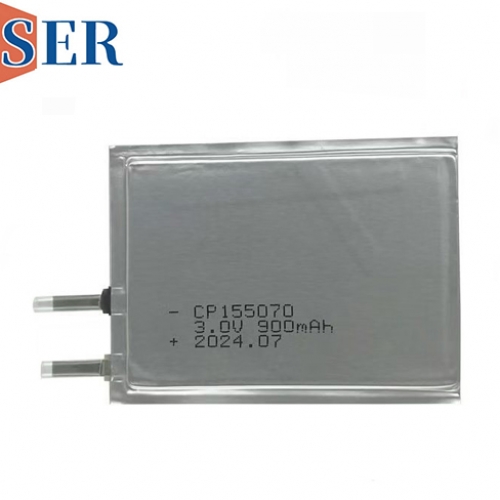
6. Flexible customization. Beyond the CP502440, SER maintains a broad catalog of CP-series thin pouches (including CP042922, CP104848, CP155050, CP202850, CP305050, CP405050, CP505050, CP783970 and others) and builds custom dimensions, terminal types and battery packs on request. There is no rigid MOQ, and lead time stays fast for prototype and trial batches.
Where This Soft Pack Battery Is Used
The CP502440 ultra thin battery and its customized siblings appear across a wide range of products:
RFID readers and active RFID tags. Long shelf life, 3.0V direct supply and pulse capability match the wake-up-transmit duty cycle of active logistics tags and access cards.
GPS and asset trackers. Personnel positioning cards, luggage trackers, container tags and vehicle loggers run for years on a single cell between transmissions; the slim pouch fits in a wallet card or a small tracker housing.
LoRaWAN and general IoT sensors. Smart-building sensors, environmental monitors, smart metering peripherals and industrial sensor nodes benefit from the flat voltage curve and low self-discharge.
Animal identification. Livestock collars and wildlife tags need light weight, rugged temperature tolerance and a multi-year service life in remote pastures.
Smart cards, security cards and ETC. At 0.4–0.6mm custom thickness, the technology powers thin embedded electronics in card form factors.
Security and alarm equipment. Smoke detectors, burglar alarm panels, door sensors and portable listening devices require maintenance-free standby for years.
Medical equipment and personal safety devices. Life-jacket lights, emergency beacons and compact medical accessories rely on instant activation and long storage.
Electronic shelf labels. Retail ESLs sit on shelves for years, making low self-discharge a primary requirement.
Customization, Documentation and Working with SER
Buyers sourcing a soft pack battery for production usually need more than a datasheet number. SER provides:
Custom dimensions, capacities and terminal/connector designs;
SER branding or fully OEM private-label packaging;
Quality documentation including UN38.3 reports and Test Summary, MSDS, air and sea transport identification documents, and support for additional safety certifications where the target market requires them;
Professional technical consultation before the prototype stage, strict quality control through the production base, and continuous supply guarantee for scaled orders;
No-MOQ sample support with fast lead time for engineering validation, followed by ramp-up into annual volume.
If the standard CP502440 does not match a customer's enclosure, SER's engineering team maps the device's required capacity, pulse current, thickness budget and connector to the closest existing CP model or designs a new soft pack, estimating mold cost and sampling cycle before commitment.
Choosing the Right LiMnO2 Battery: A Quick Buyer's Checklist
When comparing an ultra thin battery supplier, verify four points against the CP502440 platform: (1) does the published capacity match your duty-cycle math, including the RF pulse peak rather than only average current; (2) is the self-discharge rate stated per year and backed by test data, not just marketed as "long life"; (3) does the pouch thickness and terminal format physically fit the enclosure; and (4) are shipping documents (UN38.3, MSDS, transport identification) ready for air and sea freight to your destination market. The CP502440 answers yes on all four, which is why it remains a reference design for slim, long-life connected devices.
Conclusion
The CP502440 LiMnO2 soft pack battery distills everything a modern battery-powered product needs: a reliable 3.0V rail, 1200mAh of capacity in a slim 5×24×40mm pouch, 800mA pulse headroom, under-2% annual self-discharge, multi-year standby without passivation, a wide temperature window and a safe, flexible laminated structure. Whether the project is a GPS tracker, a LoRaWAN sensor, an RFID tag, a personnel card, an animal ID collar, a smoke alarm or a custom smart card, this LiMNO2 thin battery removes the classic compromise between runtime and slim enclosure size. For engineers and purchasing teams looking for a dependable ultra thin battery partner — off the shelf or fully customized, OEM branded, with no MOQ and complete shipping documentation — SER's CP-series soft pack line is worth evaluating early in the design cycle.
Contact SER today to request a CP502440 sample, a customized thin-cell quotation, or UN38.3 and MSDS documentation for your IoT, RFID or tracking project.